

Designing lighting for a grand dining room requires more than selecting a beautiful fixture. In large residential interiors, a chandelier over a dining table becomes an architectural element — defining proportion, framing the table, and reinforcing the spatial hierarchy of the room.
For homeowners, interior designers, and developers working with refined interiors, the success of a dining space depends on understanding the correct relationship between chandelier size for a dining table, ceiling height, fixture scale, and placement geometry. A well-planned dining room chandelier layout ensures visual balance, functional illumination, and long-term spatial harmony.
This dining room chandelier size guide explains how to plan lighting layouts for grand dining rooms — from selecting the correct chandelier width and determining how high a chandelier should hang above a dining table, to choosing between linear and round formats based on table geometry. Whether designing a private residence, penthouse apartment, or estate dining hall, these principles support confident, long-term lighting decisions aligned with architectural scale.
The sections below outline the core principles involved in planning lighting for grand dining rooms. Use this table of contents to navigate directly to the topics most relevant to your dining space.
Table of Contents
- Why Dining Room Lighting Layout Matters
- Fixture Shape vs Table Geometry
- Determining the Right Chandelier Size
- Standard Dining Table Sizes and Matching Chandelier Widths
- How Wide Should a Chandelier Be
- How High Should a Chandelier Hang
- Lighting Layouts for Large Dining Rooms
- Planning Lighting in Open-Plan Dining Spaces
- Structural Considerations for Large Chandeliers
- Electrical Planning for Dining Room Chandeliers
- Choosing Styles for Grand Dining Rooms
- Frequently Asked Questions About Dining Room Lighting Layout

Zarrin Valeris linear crystal chandelier suspended above a rectangular dining table, illustrating precise proportional alignment and structured light distribution within a grand dining environment.
Why Dining Room Lighting Layout Matters More Than Fixture Style
In grand interiors, the dining table is typically the central anchor of the room, and a chandelier over a dining table becomes the defining visual element of the space. Dining lighting does not simply illuminate — a properly scaled dining room chandelier establishes visual balance, reinforces symmetry, and defines the spatial rhythm of the interior.
When dining lighting layouts are planned correctly, a well-positioned chandelier above a dining table will:
- Define the dining zone clearly within the room
- Reinforce architectural symmetry through correct chandelier placement
- Create a sense of proportion between furniture, ceiling height, and chandelier size
- Enhance the perceived scale of the interior
When planned incorrectly, even expensive dining chandeliers can appear undersized, poorly positioned, or visually disconnected from the architecture — reducing both visual impact and functional performance.
How Fixture Shape Relates to Dining Table Geometry
Selecting the correct chandelier begins with understanding the shape of the dining table, not just its size. Choosing the right chandelier for a round dining table, linear chandelier for rectangular dining tables, or an oval chandelier for long dining tables ensures visual balance and reinforces symmetry along the table axis.
The examples below illustrate how different chandelier shapes for dining tables correspond to specific table formats, helping define proportion, alignment, and visual rhythm within the dining zone.

Ø 90 cm (35.4") × H 62 cm (24.4")
18K Gold-Plated Copper & Crystal
View Details
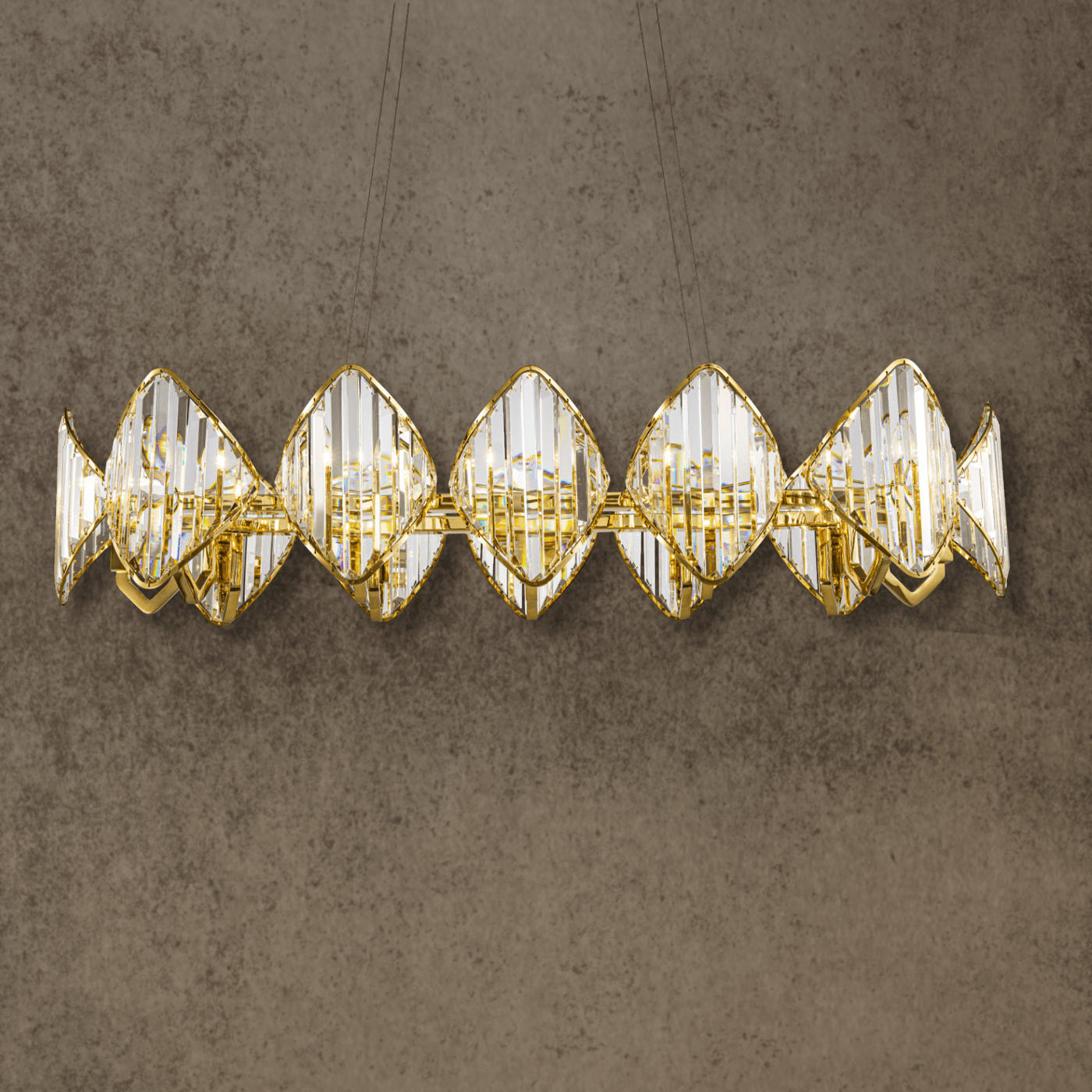
L 145 cm (57") × W 45 cm (18") × H 25 cm (10")
18K Gold-Plated Copper & A+ Grade Lead-Free Crystal
View Details

L 157 cm (62") × W 37 cm (14.5") × H 35 cm (14")
18K Gold-Plated Copper & A+ Grade Lead-Free Crystal
View Details
How Do You Determine the Right Chandelier Size for a Dining Table?
One of the most common questions asked during dining room planning is:
How large should a chandelier be above a dining table?
The correct chandelier size depends primarily on table dimensions, not room size alone, ensuring proper fixture-to-table proportion and maintaining visual balance across the dining surface.
Standard Dining Table Sizes and Matching Chandelier Widths
In most dining room layouts, the chandelier width should measure approximately 50–70% of the table width, ensuring balanced proportions without overwhelming the dining surface.
Below is a practical reference for selecting chandelier width based on table length.
| Table Length | Typical Seating | Suggested Chandelier Width |
|---|---|---|
| 180–220 cm | 6 seats | 80–100 cm |
| 240–300 cm | 8 seats | 100–140 cm |
| 300–360 cm | 10–12 seats | 140–180 cm |
| 360 cm+ | 12+ seats | 180 cm+ or multiple fixtures |
This guideline ensures that the chandelier remains visually connected to the table without overpowering it.
In large luxury dining rooms, selecting a chandelier that is too small is one of the most common mistakes. Under-scaled fixtures can disrupt proportion and diminish the perceived quality of the space.

Aurelio Wave sculptural linear crystal chandelier extending across a grand rectangular dining table, demonstrating continuous light distribution and architectural rhythm within a panoramic dining space.
How Table Shape Influences Lighting Selection
Dining tables vary significantly in shape, and lighting layout must respond accordingly.
Rectangular Dining Tables
Rectangular tables typically benefit from:
- Linear chandeliers
- Multiple smaller fixtures
- Extended suspended lighting arrangements
Rectangular tables typically benefit from linear chandeliers for rectangular dining tables that align with the table length and maintain proportional light distribution across seated positions.
For long dining tables exceeding 240–300 cm, linear chandeliers or multiple pendant lights for long dining tables provide more even illumination across the full seating span.

H 28 cm (11") × W 29 cm (11.4") × L 120 cm (47.5")
18K Gold-Plated Copper & A+ Grade Lead-Free Crystal
View Details

L 218 cm (86") × W 62 cm (24.4") × H 61 cm (24")
18K Gold-Plated Copper & Crystal
View Details

H 39 cm (15.3") × L 135 cm
Brass & Murano Style Glass
View Details
Round Dining Tables
Round tables work best with:
- Circular chandeliers
- Multi-tier fixtures
- Radial lighting forms
Round dining tables require centralised chandelier placement for round dining tables, ensuring balanced radial illumination and avoiding uneven shadow zones.
A circular chandelier for round dining tables ensures symmetrical light distribution and maintains visual balance from every seating position.

Ø 125 cm (49.2")
Solid Copper & Spanish Alabaster
View Details

Ø 100 cm (39.3") × H 54 cm (21")
Copper & Murano Style Glass
View Details

Ø 47 cm (18.5") × H 46 cm (18")
18K Gold-Plated Copper & A+ Grade Lead-Free Crystal
View Details

Alabaster Galaxia chandelier suspended above a round dining table, featuring solid Spanish alabaster spheres arranged in a radial composition.
How Wide Should a Chandelier Be Over a Dining Table?
A widely used architectural guideline is:
Chandelier width should measure approximately ½ to ⅔ the width of the dining table.
For example:
- Table width: 100 cm
- Suggested chandelier width: 50–65 cm
This ratio ensures the chandelier width over the dining table remains proportional without dominating the table surface.
However, in grand dining rooms with high ceilings, larger proportions are often desirable. Slightly increasing fixture width can strengthen visual presence and enhance the sense of scale.
How High Should a Chandelier Hang Above a Dining Table?
Suspension height plays a critical role in both comfort and visual balance.
The typical recommendation:
75–90 cm above the tabletop
This height:
- Prevents glare
- Maintains sightlines across the table
- Creates an intimate lighting atmosphere
Adjusting Height for Ceiling Elevation
Chandelier height above a dining table plays a critical role in both comfort and visual balance.
Typical adjustments:
| Ceiling Height | Recommended Drop Height |
|---|---|
| 2.7–3 m | Standard drop |
| 3–4 m | Slightly extended drop |
| 4–6 m | Extended suspension required |
| 6 m+ | Multi-tier or elongated fixture |
In grand dining halls or estate dining interiors requiring luxury chandeliers, extended suspension rods or tiered chandeliers are often required to maintain visual proportion.
Sizing Principles in Practice — Width and Drop Alignment
Plaza Crystal Linear Grande Chandelier — an architectural linear chandelier crafted in polished stainless steel with A+ grade lead-free precision-cut crystal, engineered for long rectangular dining tables requiring continuous light distribution and balanced proportional coverage.
L 240 cm (94") — proportioned for dining tables 320–400 cm (10.5–13 ft)
How Do You Design Lighting Layouts for Large Dining Rooms?
Large dining rooms require more advanced planning than smaller spaces.
Simply scaling up a single fixture is not always the best solution.
Instead, layered lighting strategies are often used.
Multi-Fixture Layouts for Extended Tables
In large dining rooms, designers may use:
- Two linear chandeliers
- Multiple smaller fixtures
- Paired symmetrical lighting arrangements
These configurations maintain balance while ensuring even light distribution across long tables.
Using Multiple Fixtures Over Large Tables
Multiple chandeliers can be highly effective when:
- Tables exceed 3.5 metres in length
- Ceilings are exceptionally high
- The room layout requires symmetry
Spacing between fixtures should be carefully calculated to maintain consistent alignment.
Incorrect spacing is one of the most common causes of uneven lighting appearance.
How Should Lighting Be Planned in Open-Plan Dining Spaces?
Open-plan dining rooms introduce additional complexity when planning dining room chandeliers and surrounding illumination. In large open layouts, lighting must be structured to define zones, maintain visual balance, and support both functional and decorative lighting layers.
Dining chandelier placement should coordinate carefully with:
- Kitchen and Dining Chandeliers for Modern and Open-Plan Interiors used above islands and dining tables
- Living room lighting elements such as ceiling fixtures, wall lighting, and architectural accent lighting
- Architectural sightlines, ensuring chandeliers remain visually centred within the dining zone without competing with adjacent lighting features
Effective zoning typically combines ambient, task, and accent lighting layers, allowing each functional area to remain visually distinct while maintaining architectural cohesion.
Establishing clear lighting zones ensures the dining chandelier remains the visual centre of the dining area while supporting adjacent living and kitchen lighting layers.

Solaris Cometa Crystal Chandelier — a sculptural linear crystal chandelier designed to define the dining zone within open-plan interiors.
Defining Dining Zones Within Open-Plan Interiors
Dining lighting plays a critical role in establishing clear dining zones within open-plan kitchen and dining spaces. In contemporary layouts where kitchens, dining areas, and living rooms share a continuous floor plan, carefully selected dining room chandeliers and kitchen island lighting help define functional areas without the need for physical partitions.
Well-planned open-plan dining lighting supports:
- Framing the dining table with a properly sized chandelier or linear pendant
- Separating kitchen and dining zones visually using coordinated kitchen island pendants and dining chandeliers
- Enhancing spatial clarity across open-plan interiors through balanced layered lighting
- Maintaining visual harmony between adjacent living, kitchen, and dining lighting elements
This zoning approach is particularly important in modern luxury open-plan homes, where lighting must define each functional area while preserving a cohesive architectural flow.

Plaza Crown Crystal Pendant Lights — a coordinated multi-pendant installation defining the kitchen island within an open-plan interior
What Structural Considerations Matter for Large Dining Chandeliers?
Beyond aesthetics, structural planning is essential for large dining chandeliers, particularly in rooms with long tables or high ceilings.
Grand-scale fixtures typically require:
- Secure mounting systems designed for chandelier loads
- Verified ceiling weight capacity
- Precise suspension alignment for visual balance
Ignoring these factors can lead to installation complications and long-term safety risks.
Fixture Weight and Ceiling Support
Large dining chandeliers often weigh substantially more than standard fixtures, especially multi-tier or crystal designs. Large multi-tier or crystal chandeliers can weigh between 40 kg and 250 kg or more, depending on scale, materials, and tier configuration.
Before installation:
- Ceiling structure should be assessed
- Reinforcement may be required
- Suspension points must be accurately positioned
These steps help ensure reliable performance and safe installation.
Electrical and Suspension Planning
Electrical preparation should occur early during dining lighting design, particularly when installing oversized fixtures.
Key considerations include:
- Cable routing aligned with fixture placement
- Accurate positioning over the dining table
- Integration of dimming and lighting controls
Modern installations often include dimming systems, scene controls, or smart lighting integration to adapt lighting levels for dining, entertaining, and ambient settings.
Early coordination helps prevent costly modifications later.
Which Chandelier Styles Work Best for Grand Dining Rooms?
While layout determines performance, style selection influences character and atmosphere.
In grand dining rooms measuring 4 metres or more in length, chandelier selection must balance visual scale, material weight, and proportional alignment with architectural features such as ceiling height and table length.


Crystal Chandeliers for Formal Dining Rooms
Crystal chandeliers remain one of the most popular choices for formal dining interiors.
They offer:
- High refractive crystal elements that enhance light dispersion
- Multi-tier compositions that emphasize vertical scale
- Structured symmetry suited to formal architectural layouts
For ceiling heights exceeding 3 metres, multi-tier crystal chandeliers create stronger visual proportion and prevent fixtures from appearing undersized within expansive volumes.

Large Plaza Crystal Linear Chandelier aligned above a long dining table in a formal luxury dining interior.
Linear Gold and Contemporary Chandeliers
Modern luxury interiors frequently use:
- Extended linear chandelier compositions
- Gold-plated structural frameworks for visual warmth
- Refined crystal accents that enhance illumination without visual clutter
Linear luxury chandelier formats are particularly effective above long dining tables, where extended fixture length distributes illumination evenly across seating positions and maintains proportional alignment with table geometry.
These designs provide strong architectural clarity while maintaining decorative refinement.

Hyperion Lumina Extra-Large Linear Chandelier suspended above an oversized dining table in a contemporary architectural dining space.
Sculptural Lighting for Modern Dining Rooms
In contemporary interiors, sculptural lighting forms can act as functional artwork.
Sculptural chandeliers are often used as statement lighting elements, establishing visual identity within modern dining environments.
These fixtures:
- Enhance spatial identity
- Introduce visual interest
- Support modern architectural language
Sculptural chandeliers are most effective when centred precisely above the dining table and proportioned to maintain clear sightlines across the space.

Alabaster Colonna Sculptural Linear Chandelier positioned above a formal dining table within a contemporary skyline interior.
How Can Dining Room Lighting Be Planned for Long-Term Performance?
Lighting layout decisions should consider not only aesthetics but also long-term functionality.
Professional planning supports:
- Reliable installation
- Easy maintenance
- Adaptable lighting control
Considering Maintenance and Access
Large crystal and multi-tier chandeliers typically require periodic cleaning every 6 to 12 months, depending on installation height and environmental conditions.
During planning:
- Access methods should be considered
- Maintenance requirements should be understood
- Fixture height should allow safe servicing
These practical details support long-term usability.
Integrating Lighting Controls and Dimming Systems
Modern dining rooms often incorporate:
- Dimmable lighting
- Layered illumination
- Scene-based lighting control
Advanced installations may also include smart lighting systems or programmable scene controls, allowing seamless transitions between dining, entertaining, and ambient lighting conditions.
This allows users to adjust light levels for:
- Formal dining
- Casual gatherings
- Evening ambience
Lighting flexibility enhances overall functionality.
Frequently Asked Questions About Dining Room Lighting Layout
How big should a chandelier be over a dining table?
Typically, chandelier width should measure ½ to ⅔ of table width to maintain proportion and balance.
How high should a chandelier hang above a dining table?
Most fixtures should hang 75–90 cm above the table surface, adjusted based on ceiling height.
Can two chandeliers be used over one dining table?
Yes. Multiple fixtures are often used for long tables exceeding 3.5 metres in length.
Are linear chandeliers better for long dining tables?
Linear chandeliers are often preferred for rectangular tables because they distribute light evenly across the table length.
What type of lighting works best in large dining rooms?
Large dining rooms often benefit from:
- Multi-tier chandeliers
- Linear arrangements
- Layered lighting strategies
These solutions maintain visual balance and functional illumination.
What chandelier styles work best for double-height dining rooms?
Double-height dining rooms typically benefit from multi-tier or vertically elongated chandeliers that maintain visual proportion across extended ceiling heights.
Final Thoughts: Planning Dining Room Lighting with Confidence
Lighting layout decisions influence far more than brightness — they shape the perception of space, proportion, and architectural identity.
In grand dining rooms, successful lighting is achieved through:
- Careful measurement
- Thoughtful placement
- Proper fixture scaling
- Coordinated installation planning
Whether designing for private residences, penthouse interiors, or large estate dining halls, applying structured layout principles ensures that lighting enhances both performance and visual harmony.
Well-planned dining lighting transforms the table from a functional surface into a central architectural feature — supporting memorable gatherings and refined living experiences.


