

In high-end American homes and residential developments, luxury chandeliers are no longer treated as decorative accessories. They are specified early in the design process and coordinated with architecture, ceiling height, and spatial scale. When chosen correctly, statement chandeliers becomes an architectural element that defines atmosphere, proportion, and perceived value within a space.
For interior designers and developers working in the U.S. luxury market, specifying luxury chandeliers is not simply about selecting beautiful fixtures. It requires understanding architectural scale, material quality, and layered lighting strategies that ensure each piece enhances the interior rather than competing with it.
In large American homes where ceilings frequently exceed 12–20 feet, grand foyer chandeliers must be carefully scaled and positioned to maintain architectural balance. The drop, diameter, and visual weight of a chandelier all influence how a space feels once illuminated.
From grand foyers and double-height staircases to formal dining rooms and luxury living spaces, chandeliers must be selected with precision to achieve balance, performance, and long-term design coherence.
This guide explains what designers and developers must consider when specifying luxury chandeliers for American homes and residential projects — and the common mistakes that cause lighting installations to feel disproportionate, overwhelming, or underpowered.
Chandeliers Designers Specify for Grand Foyers and Staircases
Tailored for high ceilings and grand entry spaces.
Typical production lead times of 8–10 weeks.
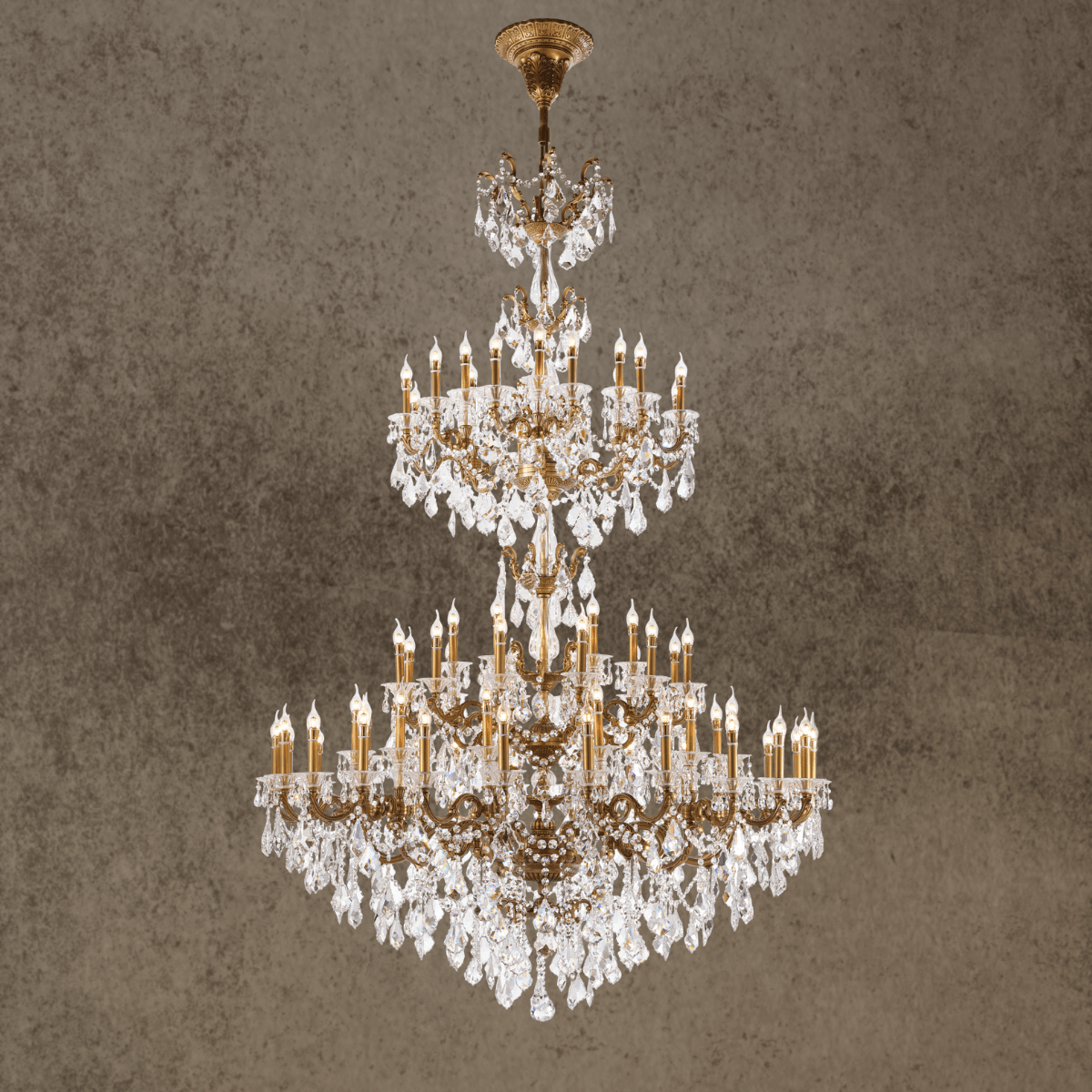
Asfour Egyptian crystal & bronze-plated copper
View Details

A+ grade lead-free crystal & stainless steel
View Details

Spanish alabaster stone & copper
View Details
- ✔ Custom sizing and CAD drawings
- ✔ Full project specification support
- ✔ Specified by designers worldwide
- ✔ Typical production time: 8–10 weeks
Our team typically responds within 24 hours — Contact our team .
How Designers Choose the Best Chandeliers for Luxury Foyers, Entryways, and High-End Homes

Donatello Grande - luxury chandelier in Murano-style amber glass and gold defining the architectural scale of a grand foyer in a high-end American home.
In high-end residential design, luxury chandeliers are often the defining element of a space. The best chandeliers for luxury homes do more than illuminate a room — they establish hierarchy, scale, and visual rhythm within the architecture.
This is particularly important in foyers and entryways, where lighting becomes the first spatial statement a visitor encounters. In large American homes, these areas frequently feature double-height ceilings, curved staircases, and open circulation zones. A chandelier placed here must therefore balance architectural scale, drop height, and light distribution.
When designers evaluate the best chandeliers for foyers and entryways, several principles guide the specification:
• Architectural scale — the chandelier diameter must correspond to the width and height of the space
• Vertical composition — multi-tier or sculptural forms help occupy tall volumes without feeling undersized
• Material presence — crystal, glass, or sculptural metal structures must carry visual weight during both day and evening
• Lighting performance — the chandelier must contribute to layered lighting rather than acting as the only light source
In high-end homes, luxury chandeliers are rarely chosen purely for decoration. Designers evaluating chandeliers for high ceilings often consider proportion, drop height, and material presence.
Choosing the Right Chandelier Size for High Ceilings, Staircases, and Grand Foyers

Montclair Crystal Chandelier installed in a high-ceiling open-plan living room, illustrating how large chandeliers define scale in luxury American homes.
One of the most common mistakes in luxury residential projects is selecting chandeliers that are visually impressive in isolation but incorrectly scaled for the architecture of the home. In large American residences, ceiling heights frequently exceed 12 to 20 feet, and entry halls, staircases, and living areas are often designed as expansive open volumes.
These architectural conditions require chandeliers that are proportioned specifically for the space. A fixture that appears substantial in a showroom or catalogue may feel surprisingly small once installed in a double-height foyer or staircase hall.
Luxury homes in the United States often feature:
• Double- and triple-height entry halls where chandeliers must fill significant vertical volume
• Grand staircases with open balustrades that expose the lighting fixture from multiple levels
• Expansive living areas with minimal partitions where lighting must anchor the architecture
When chandeliers are selected without accounting for this spatial scale, they can feel undersized, visually disconnected from the architecture, or unable to illuminate the room effectively.
Why Layered Lighting Is Essential in Luxury Residential Design

Solaris Ignis crystal wall sconce in 18K gold-plated copper, designed to complement statement chandeliers while adding layered architectural lighting to luxury interiors.
Chandeliers alone rarely create a complete lighting scheme. In large luxury residences, lighting must be layered and integrated into the architecture.
One of the most effective ways designers achieve this balance is through large luxury wall sconces that support the chandelier while introducing vertical rhythm across the space. Designers often select sculptural wall lighting with substantial materials and scale — characteristics that define true luxury wall sconces.
In high-end American homes — where ceilings are tall and rooms often span wide open volumes — luxury chandeliers act as the visual centrepiece, while luxury architectural sconces add depth, warmth, and spatial balance.
For this reason, designers frequently specify large luxury sconces alongside grand chandeliers, ensuring that lighting feels intentional, balanced, and comfortable from every vantage point.
Premium Materials and Noble Craftsmanship in Luxury Lighting

Precision-cut A+ grade lead-free crystals paired with 18K gold-plated copper, showcasing the noble materials used in high-end luxury HDLS chandeliers.
Luxury clients in the United States increasingly view lighting not as decorative object but as a long-term architectural investment. The materials specified today must age well, remain relevant, and structurally sound decades into the future.
For this reason, experienced designers prioritize premium materials — materials selected for their craftsmanship, durability, and ability to age gracefully within the architecture.
High-end lighting is typically crafted from materials such as:
• Precision-cut crystal — including Swarovski, Asfour Egyptian crystal, and A+ grade lead-free crystal — valued for its clarity and the way it refracts and animates light throughout a space.
• Murano-style glass — hand-formed glass inspired by Venetian craftsmanship, celebrated for its sculptural character and luminous depth.
• Premium metals such as solid brass or solid copper, often finished in gold or bronze, providing structural integrity while developing rich patina over time.
These materials do more than support the structure of a chandelier or wall sconce. They shape how light interacts with the architecture, influencing reflections, depth, and atmosphere throughout a room.

Ø 95 cm × H 40 cm
18K gold plated copper & A+ grade lead-free crystal
View Details

Ø 95 cm × H 82 cm
Murano-style glass & 18K gold plated copper
View Details

Ø 125 cm
Spanish alabaster stone & precision copper structure
View Details

Donatello Eleganza — a Murano-style glass chandelier designed to anchor heritage interiors, adding depth, warmth, and sculptural presence to architectural spaces.
Work with our team to specify scale, materials, and suspension for your space.
When Custom or Bespoke Lighting Becomes Essential in Luxury Interiors

Bespoke cascading crystal chandelier designed for a grand spiral staircase, illustrating how custom lighting installations elevate scale and architectural drama in luxury American homes and estates.
Not every project requires fully bespoke lighting. However, in many luxury residential and hospitality interiors, custom lighting or bespoke chandeliers become essential to achieve the correct architectural balance.
Unlike standard decorative fixtures, custom lighting solutions are designed around the scale, geometry, and material palette of a specific space. This approach ensures the lighting integrates seamlessly with the architecture rather than appearing added after the fact.
Custom or bespoke lighting is typically necessary when:
• Ceiling heights exceed standard proportions, requiring tailored chandelier drop lengths or multi-tier structures.
• Staircases, voids, or double-height spaces demand lighting designed specifically for vertical architectural volumes.
• Interior material palettes are tightly controlled, requiring metals, finishes, or glass elements to match surrounding architecture.
• Symmetry or repetition across multiple floors requires coordinated lighting systems rather than individual fixtures.
At HDLS Lighting Ltd, many projects combine architectural chandeliers, custom dimensions, and noble materials such as crystal, Murano-style glass, and precision-finished metals. This approach provides the flexibility designers require without compromising craftsmanship or longevity.
Electrical and Installation Requirements for Luxury Chandeliers in the USA

Petra Obsidian Rectangular Chandelier in matte black brass and glass, demonstrating the scale and electrical planning required when installing luxury chandeliers in high-end American interiors.
When specifying luxury lighting in the United States, designers and developers must consider technical and regulatory requirements alongside aesthetics.
Luxury chandeliers and lighting used in American residential projects must comply with U.S. electrical standards and safety certifications, particularly when installed in large homes, staircases, and double-height spaces.
Key technical considerations include:
• UL, ETL, or CSA certification, ensuring fixtures meet U.S. safety and installation standards.
• Compatibility with U.S. voltage systems (110–120V), including dimming and driver configuration.
• Fixture weight and ceiling load capacity, particularly for large chandeliers installed in grand foyers or staircase voids.
• Installation sequencing, ensuring lighting can be installed safely within the construction schedule.
• Lead times and aftercare, especially for custom or made-to-order lighting.
Ignoring these factors early in the design process can lead to delays, redesigns, or compromised installations.
Why Luxury Chandeliers Increase Property Value in High-End American Homes

Alabaster Colonna vertical pendant light crafted from Spanish alabaster stone and copper, demonstrating how sculptural lighting enhances double-height luxury interiors.
In high-end American homes, luxury chandeliers are increasingly viewed not as decorative accessories but as architectural investments. When placed in grand entry halls, double-height living rooms, or sweeping staircase voids, a well-specified chandelier becomes far more than a source of illumination — it becomes a defining feature of the property itself.
In competitive luxury markets such as Beverly Hills, Miami, Palm Beach, and New York, distinctive architectural elements help properties stand apart. A chandelier crafted from noble materials — including precision-cut crystal, Murano-style glass, Spanish Alabaster stone, and premium finished metals — can translate directly into greater perceived property value, stronger marketing imagery, and a more memorable first impression for potential buyers.
By contrast, generic or poorly scaled lighting can diminish architectural intent. Even beautifully designed homes may feel visually incomplete when large spaces are paired with undersized or low-quality fixtures.
For this reason, many designers and developers now treat luxury chandeliers as part of the core architectural strategy of a property. When proportion, craftsmanship, and materials are carefully considered, a chandelier becomes an enduring feature that enhances both the experience and long-term value of a high-end American home.
Specifying Luxury Lighting with Confidence
In high-end American residences, the right chandelier or architectural fixture does more than illuminate a room. It establishes proportion, anchors the interior composition, and contributes to the long-term character and value of the property.
For designers, architects, and developers, specifying decorative lighting therefore requires more than selecting beautiful fixtures. It requires collaboration with lighting specialists who understand architecture, materials, and the demands of luxury residential projects.


