

Why Are Luxury Chandeliers So Expensive?
Luxury chandeliers are expensive because they are engineered as long-term architectural investments — not mass-produced decorative fixtures.
When people ask, “Are expensive chandeliers worth the investment?” they are often comparing a $500 decorative fixture to a $10,000–$50,000 handcrafted architectural chandelier designed for estate-level interiors. The difference lies not merely in design, but in noble materials, engineering precision, structural integrity, and generational longevity.
At HDLS Lighting Ltd, chandelier design is approached as a discipline of craftsmanship and architectural intent. Investment-grade luxury chandeliers are constructed from solid brass or copper frameworks, Murano-style glass, Spanish alabaster, and precision-cut Asfour or Swarovski crystals, then refined through hand-forging and 18K gold electroplating. These materials are selected not for trend, but for permanence, performance, and enduring presence within refined interiors.
In luxury homes across the United States, chandeliers are rarely chosen as simple decorative fixtures. They are architectural centrepieces designed to define entire rooms.
• Interior designers specifying architectural lighting
• Developers planning long-term investment-grade installations
• Buyers evaluating whether premium chandeliers justify their cost
Understanding chandelier cost requires evaluating more than appearance. It means assessing material quality, structural engineering, safety standards, and long-term durability — the very factors that determine whether a chandelier becomes a temporary expense or a lasting design asset.
Élysée Grand Impériale — An Architectural Investment Centerpiece
Chandeliers of this scale are not selected as decorative accessories — they are specified as architectural centrepieces designed to remain in place for decades. The Élysée Grand Impériale is constructed from solid copper, electroplated in 24K gold — a material combination chosen for structural integrity, corrosion resistance, and enduring visual presence. Within luxury estates, boutique hotels, and heritage properties, lighting of this calibre becomes part of the architecture itself, defining spatial identity, enhancing perceived property value, and remaining relevant across generations.


Specify the Élysée Grand Impériale for Your Architectural Project
Our design team collaborates with architects, designers, and estate owners to coordinate scale, suspension geometry, and installation planning for landmark interiors.
Design and Engineering: What Separates Decorative Lighting from Investment-Grade Luxury Chandeliers
Every luxury chandelier begins as a design concept — but only investment-grade chandeliers are engineered to justify their higher cost. At HDLS Lighting Ltd, design and engineering evolve simultaneously to ensure structural stability, safety compliance, and long-term architectural performance.
While visual beauty defines first impression, structural engineering determines why luxury chandeliers are more expensive than mass-produced fixtures. The weight of solid brass or copper frameworks, the distribution of crystal or glass elements, and the integration of electrical systems must be calculated precisely to prevent sagging, imbalance, or premature failure.
Mass-produced decorative lighting often prioritizes appearance over durability. Without reinforced joint construction, proper load distribution, and certified electrical components, fixtures may lose alignment or fail within a few years. By contrast, investment-grade chandeliers are built to meet international safety standards and to maintain structural integrity for decades — which directly influences luxury chandelier cost.
Through collaboration between designers, engineers, and master artisans, each chandelier is refined to unite artistic expression with technical precision. This integration of design and engineering is a fundamental reason why expensive chandeliers hold long-term value.
How Engineering Determines the Correct Placement of a Luxury Chandelier
Investment-grade chandeliers are engineered not only for durability, but for the environments they serve. In formal reception rooms and classic estate interiors, structural balance ensures long-term alignment while preserving architectural symmetry.
Within formal living rooms and private studies, controlled weight distribution supports stable central placement. Linear installations above luxury kitchen islands, bars, and boardroom tables require precise suspension geometry and load calculations to maintain both safety and proportion.
The following chandeliers demonstrate how engineering decisions determine where luxury lighting performs best — transforming illumination into enduring architectural structure.
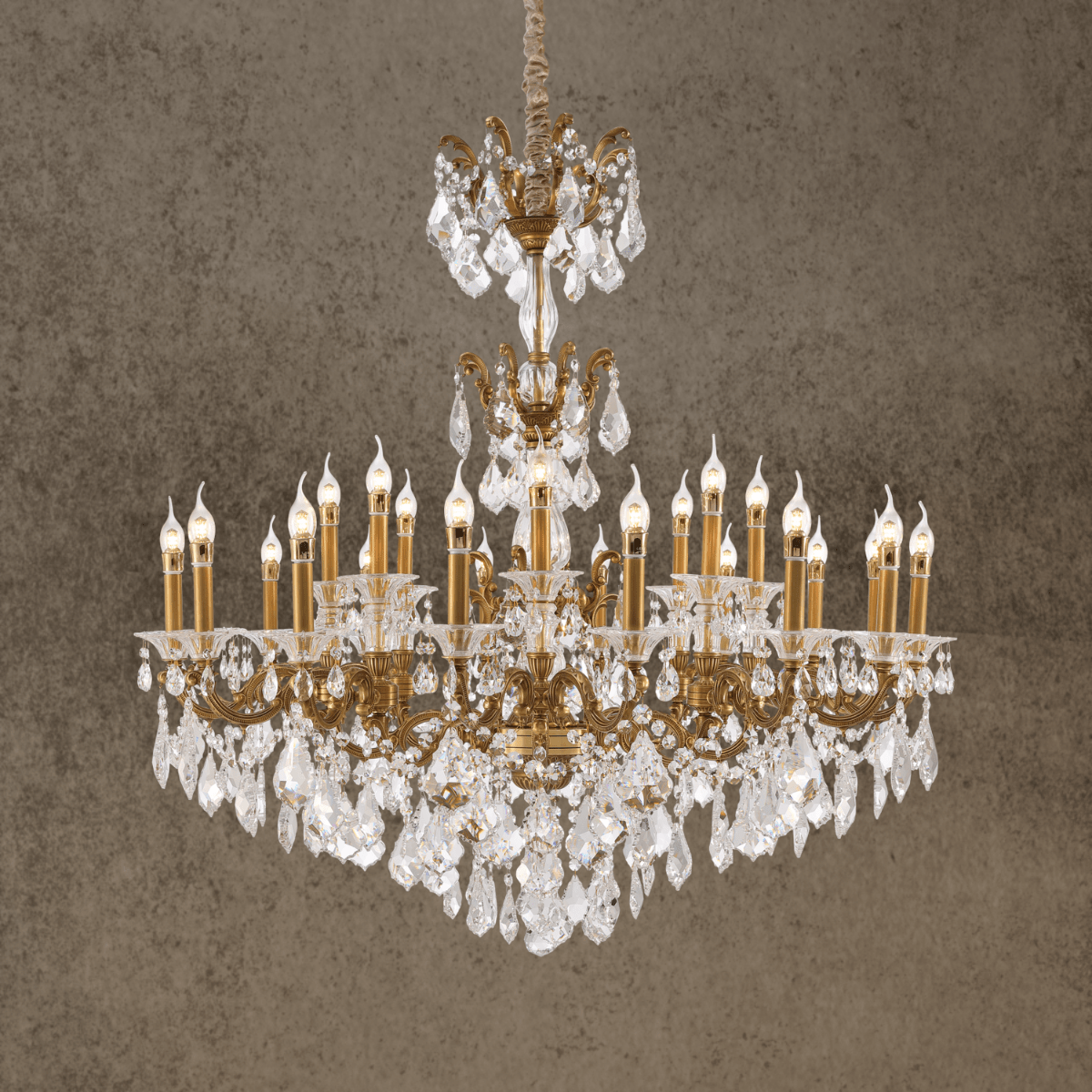
Ø 117 cm (46") × H 118 cm (46")
Asfour Crystal & Bronze-Plated Copper
View Details
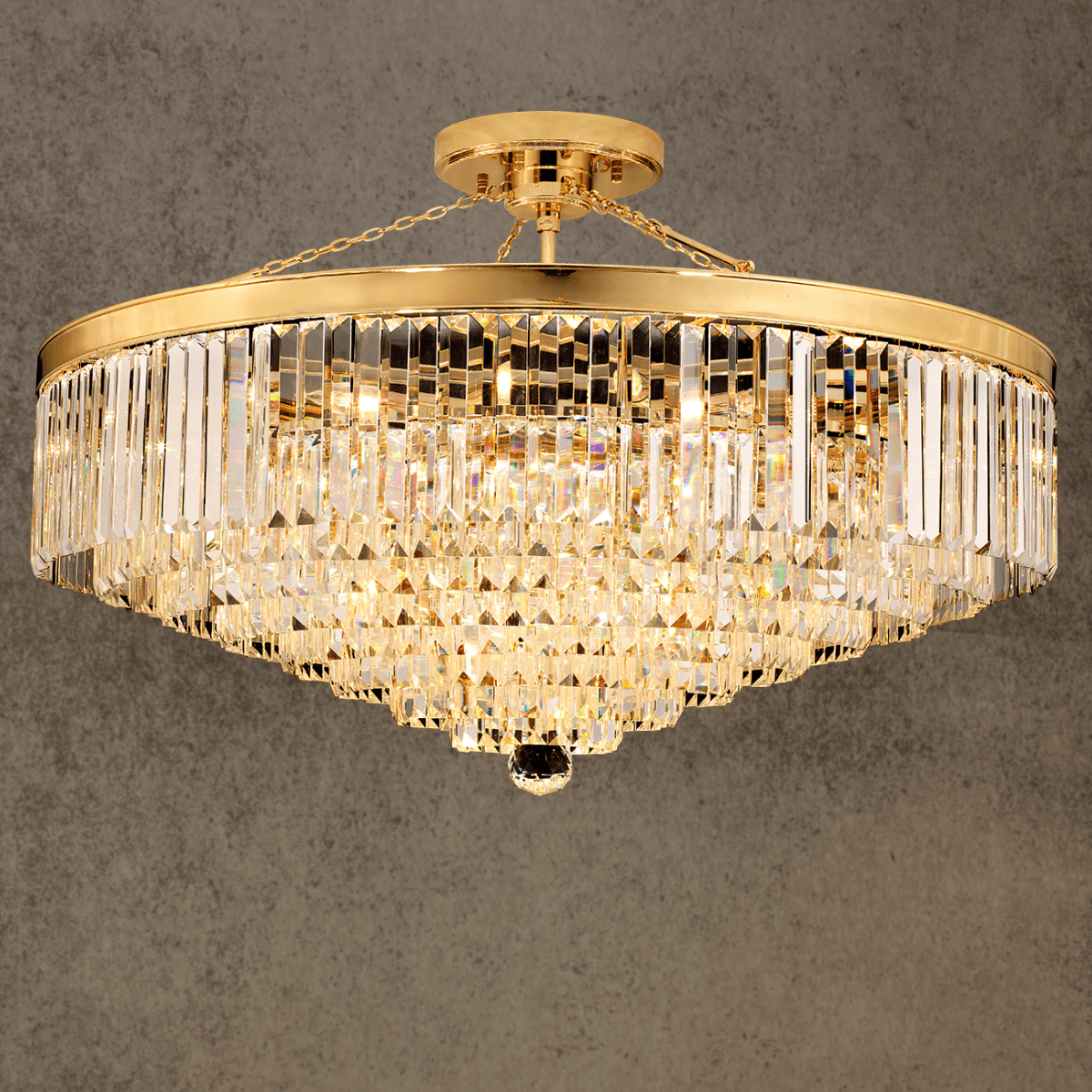
Ø 107 cm (42") × H 45 cm (17.7")
18K Gold-Plated Copper & A+ Grade Lead-Free Crystal
View Details

L 218 cm (86") × W 62 cm (24.4") × H 61 cm (24")
18K Gold-Plated Copper & Crystal
View Details
Specified for private estates, penthouses, and luxury residential and hospitality projects throughout the United States.
Private consultation available for residential, hospitality, and architectural lighting projects worldwide. Access trade pricing →
 Imperial Grace Regina — Estate-Scale Bronze and Asfour Crystal Crafted for Grand Architectural Interiors.
Material Quality: The Noble Materials That Define Luxury Chandeliers
Material selection is one of the clearest indicators of whether a chandelier truly justifies its cost — or simply imitates luxury. At HDLS Lighting Ltd, every piece is constructed from noble materials chosen for performance, longevity, and architectural presence.
Precision-cut crystal — including Asfour Egyptian and Swarovski crystal — delivers superior clarity, brilliance, and long-term transparency. Unlike molded glass or acrylic substitutes, it refracts light with sharp precision and does not cloud over time.
Solid brass and copper frameworks provide structural strength and balanced weight distribution. These metals resist corrosion and allow advanced finishing techniques such as 18K gold electroplating, ensuring durability and refined ageing.
Murano-style glass, handcrafted by master artisans, introduces sculptural depth and individuality. Each element reflects light organically, creating dimensional brilliance impossible to replicate through mass production.
Spanish alabaster stone diffuses illumination naturally, producing a soft architectural glow that synthetic materials cannot achieve.
By contrast, mass-market chandeliers often rely on thin alloys, plastics, or acrylic components — materials that compromise structural integrity and long-term value. Noble materials are what distinguish decorative lighting from investment-grade architectural chandeliers.
Investment-Grade Murano-Style Glass Chandeliers Crafted as Architectural Sculpture
Murano-style glass chandeliers are handcrafted architectural compositions designed to retain visual impact and material integrity for decades. Each glass element is individually formed by master artisans, creating dimensional texture, organic light refraction, and sculptural presence beyond mass production.
Paired with solid brass or 18K gold-plated copper frameworks, these chandeliers become long-term design investments selected for enduring artistic and architectural value.


Specify an Investment-Grade Murano-Style Glass Chandelier for Your Project
Our team collaborates with homeowners, designers, and architects to guide proportion, suspension planning, and installation preparation for refined architectural integration.
Hand Forging and Structural Craftsmanship: Why Luxury Chandeliers Cost More
Hand forging is one of the key reasons luxury chandeliers are more expensive than mass-produced lighting. In investment-grade designs, structural components — including arms, frames, and load-bearing joints — are crafted from solid brass or copper rather than stamped from thin alloy.
Precision welding, manual bending, and reinforced joint construction allow for millimetric control over balance and weight distribution. This level of structural refinement cannot be replicated through automated production.
Because luxury chandeliers often carry significant material weight — crystal, glass, or alabaster — structural engineering becomes essential. Hand forging ensures long-term alignment, stability, and safety under continuous load.
Mass-market chandeliers are typically machine-stamped using lightweight metals and simplified assembly methods. While visually similar at first glance, they lack the structural integrity required for decades of performance.
This distinction is not decorative — it directly impacts durability, safety, and long-term value, defining the difference between high-end decorative lighting and investment-grade architectural chandeliers.
 Hand-polishing copper chandelier arms before gold electroplating — a critical step that defines the precision and longevity of the final finish.
 Luce Regale Avorio Magnifica — a handcrafted 16-light Murano-style glass chandelier with an 18K gold-plated copper frame, created as an investment-grade centrepiece for luxury interiors.
18K Gold Electroplating: The Finishing Process That Preserves Value
Once structural engineering is complete, a luxury chandelier enters one of its most defining stages: 18K gold electroplating. This finishing process is a key reason why high-end chandeliers command a higher price.
Applied through multiple stages of preparation, chemical treatment, polishing, and controlled gold layering, electroplating protects the solid brass or copper framework beneath. When executed correctly, it enhances corrosion resistance, maintains tonal depth, and prevents premature tarnishing.
Unlike painted or lacquered finishes often used in mass-produced lighting, genuine 18K gold electroplating bonds to the metal surface. The result is a finish that retains warmth, clarity, and structural integrity for decades — not just years.
This level of finishing is present in collections such as the Maria Crystal Collection, where hand-forged copper and precision-applied gold converge to create chandeliers designed to mature gracefully rather than deteriorate over time.
Here, cost reflects expertise, material value, and long-term permanence — not excess.
 18K gold electroplating in progress — sealing hand-polished copper with a protective, luminous finish designed to last for decades.
Crystal Quality: Why Asfour and Swarovski Chandeliers Cost More
Crystal quality is one of the most significant factors influencing the cost of a luxury chandelier. At HDLS Lighting Ltd, we exclusively use precision-cut Asfour Egyptian crystal and Swarovski crystal — two of the most respected names in architectural crystal manufacturing.
Asfour crystal, produced in Egypt, is known for its exceptional clarity, sharp faceting, and balanced light refraction. Each element is precision-cut to maximise brilliance while maintaining structural weight and durability.
Swarovski crystal, crafted in Austria, represents the global benchmark in crystal engineering. Its proprietary cutting technology and high chemical purity deliver superior radiance, edge definition, and long-term optical stability. Beyond lighting, Swarovski crystal is also used in large crystal wall art installations designed for luxury interiors and statement architectural spaces.
Unlike moulded glass, acrylic, or low-grade crystal alternatives — which can dull, scratch, or cloud over time — genuine precision-cut crystal retains transparency and brilliance for decades. This difference in material quality directly affects both chandelier price and long-term value.
Investment-Grade Crystal Chandeliers Built for Architectural Longevity
The following chandeliers demonstrate how precision-cut crystal, reinforced metal frameworks, and engineered suspension systems combine to create lighting installations designed to perform for decades — not just decorate a room.


Specify an Investment-Grade Crystal Chandelier for Your Project
Our team collaborates with homeowners, designers, and architects to guide scale selection, suspension planning, and installation preparation for long-term architectural performance.
 Hand-set Swarovski® crystal defining long-term value in investment-grade luxury chandeliers.
Electrical Engineering and Quality Control: Why Luxury Chandeliers Command a Premium
Luxury chandeliers cost more in part because of advanced electrical engineering and strict safety compliance. Every fixture must meet certification standards across the U.S., UK, EU, and Canada — ensuring long-term performance and peace of mind.
This process includes:
- Selecting certified bulb bases (E14, E27, G9, or integrated LED)
- Calibrating lumens, colour temperature, and dimmability
- Ensuring compatibility with smart-home systems
- Testing voltage stability, grounding, and regional compliance
After final assembly, each chandelier undergoes extended live testing to verify light distribution, structural balance, and electrical integrity. Every component is inspected before approval.
Mass-produced fixtures often simplify wiring and testing to reduce cost. Investment-grade chandeliers do not. Engineering precision is not decorative — it directly influences safety, durability, and long-term value.
White-Glove Delivery and Long-Term Ownership
High-end chandeliers require specialised packaging and white-glove handling to ensure flawless arrival — particularly for large-scale architectural lighting projects.
Each crystal, metal component, and accessory is individually secured using shock-absorbent materials, reinforced crating, and vibration control systems. International shipments are engineered to minimise movement and pressure throughout transit.
From workshop to ceiling, handling reflects the same precision applied during fabrication — ensuring that what arrives is not merely complete, but uncompromised.
 Imperial Grace Shine — bronze-plated copper and Asfour crystal crafted for grand dining rooms and timeless estates.
Final Verdict: When an Expensive Chandelier Becomes a True Investment
Yes — expensive chandeliers are worth the investment when their higher cost reflects superior materials, structural engineering, and long-term performance.
Luxury chandeliers command a premium price because they incorporate solid brass or copper frameworks, precision-cut crystal, authentic stone or handcrafted Murano-style glass, reinforced load-bearing construction, certified electrical systems, and advanced finishing processes such as 18K gold electroplating. These elements directly influence durability, safety, and long-term architectural value.
Mass-produced fixtures may offer short-term affordability, but they rarely deliver the structural integrity or material permanence required for estate-level interiors.
When selected with intention, a high-end chandelier becomes a lasting design asset — one that reflects craftsmanship, permanence, and generational legacy.
Explore our grand-scale and crystal chandelier collections, or begin a bespoke lighting consultation to create a piece engineered to endure.
We support architectural lighting projects across Switzerland, Germany and Austria, delivering investment-grade grand-scale chandeliers engineered for villas, hotels and double-height interiors.


