

Choosing a luxury chandelier is not simply about selecting an attractive light fixture — it is about selecting a piece that complements the architectural style of the home itself.
Across the United States, residential architecture varies widely, from contemporary glass residences in California and New York to traditional estates in Texas and Virginia, coastal homes in Florida, and transitional interiors found throughout cities like Chicago, Atlanta, and Seattle. Each of these environments calls for a chandelier that responds to its scale, materials, and design language.
A modern minimalist living room, for example, often benefits from sculptural contemporary chandeliers with clean silhouettes and refined metals, while classical American homes are typically enhanced by traditional crystal chandeliers that reinforce symmetry and grandeur. Transitional interiors frequently combine both approaches, pairing elegant lighting forms with balanced materials that bridge modern and traditional design.
In this guide, we explore several chandelier styles commonly used in American homes, including modern luxury chandeliers for contemporary living rooms, farmhouse chandeliers for dining rooms, traditional crystal chandeliers for grand foyers, contemporary chandeliers for entryways and staircases, and transitional chandeliers suited to elegant open-plan interiors. Each section highlights the types of spaces where these chandeliers perform best and how they complement different architectural environments.
Popular Chandelier Styles in American Homes
- Modern luxury chandeliers for contemporary living rooms
- Farmhouse chandeliers for dining rooms
- Crystal chandeliers for grand foyers
- Contemporary chandeliers for staircases and entryways
- Transitional chandeliers for open-plan interiors
Not sure which style suits your architecture? Our specialists help match chandelier scale to ceiling height and layout.
Installation & Coordination
Our chandeliers are engineered for architectural spaces across the United States. We coordinate suspension heights, weight distribution, and electrical compatibility to ensure safe and precise installation in stairwells, foyers, and double-height interiors.

Athena Grand Tiered Crystal Chandelier suspended in a double-height luxury living room with grand windows and elegant architectural design.
Modern Luxury Chandeliers for Contemporary Living Rooms
Contemporary American homes are often defined by open floor plans, expansive glazing, and refined architectural materials such as marble, natural stone, wood, and brushed metals. In these interiors, lighting must complement the clean geometry of the space while introducing sculptural presence. For this reason, many designers select a modern luxury chandelier that enhances the architecture without overwhelming it.
In open-plan living spaces, a modern chandelier for the living room often becomes the visual centrepiece of the interior. Contemporary designs typically feature balanced proportions, elegant silhouettes, and carefully finished metals rather than heavy ornamentation. Sculptural chandeliers crafted from Murano-style glass, precision-cut crystal, alabaster, or brushed brass can introduce texture and luminosity while maintaining the refined aesthetic associated with modern homes.
A chandelier for a modern home is frequently placed within spaces where architecture and lighting interact most strongly. Large living rooms, double-height spaces, and minimalist dining areas benefit from contemporary lighting that defines volume and proportion. Linear chandeliers are often selected above long dining tables, while round or sculptural fixtures create dramatic focal points in modern living areas.

L 360 cm (142") × W 81 cm (32") × H 60 cm (24")
Brass & A+ Grade Lead-Free Crystal
View Details

Ø 115 cm (45") × H 61 cm (24")
18K Gold-Plated Copper & Crystal
View Details

Ø 100 cm (39.3") / 85 cm (33.4") / 50 cm (19.6")
Murano Style Glass & Copper
View Details

Luce di Roma Theia modern luxury chandelier in champagne crystal and 18K gold-plated copper, creating a focal point in a contemporary American living room.

Luce di Roma Hestia — a round modern luxury chandelier crafted in 18K gold-plated copper with champagne crystal above a contemporary American dining table.
Farmhouse Chandeliers for Dining Rooms
Farmhouse-style homes remain one of the most recognizable residential architectural styles across the United States. From modern farmhouse estates in Texas and California to rustic country homes throughout the Midwest and mountain regions, these interiors emphasize warmth, natural materials, and a sense of relaxed elegance.
Within these homes, the dining room often becomes the heart of the interior, making the choice of a farmhouse chandelier for the dining room particularly important when designing elegant kitchen and dining spaces. A well-chosen farmhouse dining room chandelier typically combines simple structural forms with organic materials such as wood, aged metal, or hand-finished iron. Candle-style chandeliers are especially popular in farmhouse interiors, offering a timeless silhouette that complements both traditional country homes and modern farmhouse designs.
In many modern farmhouse homes, a chandelier above the dining table becomes the defining element of the room. Designers frequently choose linear chandeliers for long dining tables, allowing the lighting to follow the proportion of the table while distributing light evenly across the space. This approach is particularly effective in large open-plan farmhouse interiors, where a well-scaled chandelier helps visually anchor the dining area within the broader architectural layout.
The farmhouse chandeliers below are selected to complement modern farmhouse dining rooms, long dining tables, and open-plan kitchen and dining spaces. Each design reflects the balance of warmth, proportion, and simplicity that defines contemporary farmhouse interiors.

L 130 cm (51") × W 38 cm (15") × H 42 cm (16")
Copper & Spanish Alabaster
View Details

L 126 cm (50") × W 36 cm (14") × H 39 cm (15")
Murano Style Glass & Brass
View Details

L 137 cm (54") × W 36 cm (14") × H 83 cm (33")
Brass & Glass
View Details
Designed for 110–120V U.S. standards • UL-compatible configurations available • 8–10 week production lead times • White-glove international delivery
For trade pricing and size guidance, contact our specialists.

Hyperion Lumina Linear Chandelier illuminating a large farmhouse-style dining table in a contemporary American home.
Crystal Chandeliers for Grand Foyers
In many American luxury homes, the foyer is designed to create a powerful first impression. From classical estates in the Northeast to grand residences in Texas and California, the entrance hall often features soaring ceilings, sweeping staircases, and dramatic architectural volume. In these spaces, a crystal chandelier for the foyer becomes more than decorative lighting — it serves as the visual centerpiece that defines the atmosphere of the home from the moment guests arrive.
A well-proportioned grand foyer chandelier introduces elegance, symmetry, and brilliance to large entry halls. Traditional classic crystal chandeliers remain especially popular in these environments because their layered prisms and reflective surfaces interact beautifully with natural daylight and interior lighting such as large wall sconces. The result is a luminous focal point that enhances marble floors, sweeping staircases, and the refined architectural detailing commonly found in luxury American homes.
Because many foyers feature significant vertical volume, selecting the correct chandelier for high ceilings is essential. Multi-tiered crystal chandeliers are frequently specified for these spaces, allowing the fixture to follow the height of the room while distributing light throughout the entry hall. In homes with dramatic staircases, designers often choose a staircase crystal chandelier that descends through the center of the stairwell, visually connecting multiple levels of the home.
Grand foyer chandeliers are typically specified for ceilings between 18–30 feet. Multi-tier crystal chandeliers and cascading staircase fixtures are ideal for homes with sweeping staircases, double-height entry halls, and large architectural volumes.

Ø 150 cm (59") × H 230 cm (90")
18K Gold-Plated Copper & A+ Grade Lead-Free Crystal
View Details

Ø 150 cm (59") × H 220 cm (87")
Stainless Steel & A+ Grade Lead-Free Crystal
View Details

Ø 175 cm (69") × H 245 cm (97")
A+ Grade Lead-Free Crystal & Iron
View Details
Custom suspension lengths are available to suit staircase voids and multi-level entry halls.

Versailles Le Bleu crystal chandelier illuminating a grand double-staircase foyer — a statement staircase crystal chandelier designed for high-ceiling luxury homes.
Contemporary Chandeliers for Entryways and Staircases
In many modern American homes, the entryway and staircase establish the visual tone of the interior. Large open foyers, floating staircases, and double-height spaces often call for lighting that complements contemporary architecture while providing a strong focal point. A contemporary chandelier for an entryway typically features clean silhouettes, balanced proportions, and refined materials such as glass, brushed brass, or polished metal.
For staircases with dramatic vertical space, designers frequently select a modern staircase chandelier that visually connects multiple levels of the home. These fixtures are often suspended through stairwells or positioned above the landing to emphasize the height and openness of the architecture. Sculptural designs, layered glass elements, and linear compositions are particularly well suited to modern interiors where lighting becomes part of the spatial design.
Staircase Chandeliers for Vertical Architectural Spaces
Installation Logic
Staircase chandeliers are designed to respond to vertical movement and sightlines across multiple levels. Height progression, viewing angles, and structural spacing determine the overall composition, ensuring the fixture enhances the architecture rather than overwhelming it.
In tall stairwells and multi-level entry halls, layered or cascading forms allow illumination to follow the natural rhythm of the space, creating continuity between floors while maintaining visual clarity from every level.

Height: Adjustable up to 385 cm (151")
Diameter: 88 cm (34.6")
Murano Style Glass & Brass
View Details →

Height: 280 cm (110") & 180 cm (71")
Width: 38 cm (15") · Customisable
Spanish Alabaster Stone & Copper
View Details →
For trade pricing and size guidance, contact our specialists .
Custom suspension planning and drop guidance provided for staircase voids and multi-level entry halls.

Aurora Lava chandelier cascading through a sculptural staircase void, composed in Murano-style glass and brass to create vertical rhythm and refined architectural illumination for multi-level interiors.
Transitional Chandeliers for Open-Plan Living Spaces
Many contemporary American homes are designed with open-plan layouts that connect the kitchen, dining area, and living room into a single expansive space. In these interiors, lighting must create visual continuity while still defining different zones of the home. A transitional chandelier is particularly well suited to these environments because it blends the clean lines of modern design with the warmth and detail of traditional lighting.
In open-plan interiors, designers often select transitional chandeliers for living and dining spaces that feature balanced proportions, refined metal finishes, and subtle decorative elements such as glass accents or crystal drops. These fixtures complement a wide range of architectural styles, from modern townhouses to classic American residences with contemporary renovations.
Placed above a dining table, kitchen island, or central seating area, a well-scaled transitional chandelier for open-plan interiors helps unify the space while maintaining a sense of elegance. By bridging traditional craftsmanship with modern simplicity, transitional lighting creates harmony across the connected living areas of today’s luxury homes.
Placement Strategy
In open-plan interiors, chandelier placement defines visual zones within the larger architectural volume. Dining tables, kitchen islands, and central seating areas each require proportioned lighting that establishes structure without interrupting the flow of the space.
Transitional chandeliers are particularly effective in these layouts because their balanced forms create continuity between modern finishes and classic materials, allowing multiple lighting elements to feel unified across connected living areas.

L 150 cm (59") × W 25 cm (10") × H 24 cm (9.4")
Leather · Asfour Crystal · Stainless Steel
View Details

Ø 110 cm (43.3") × H 55 cm (21.7")
18K Gold-Plated Copper · A+ Grade Lead-Free Crystal
View Details
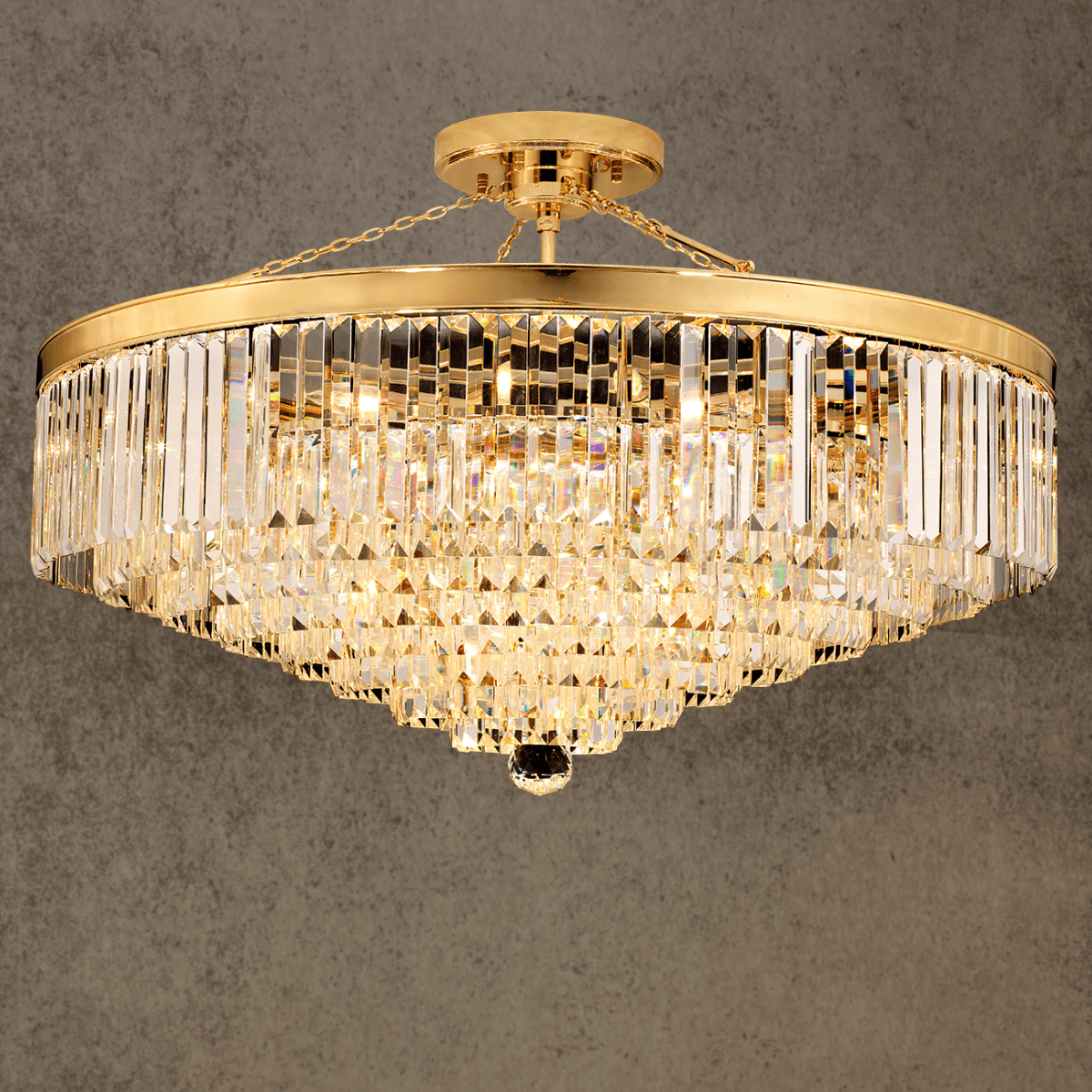
Ø 107 cm (42") × H 45 cm (17.7")
18K Gold-Plated Copper · A+ Grade Lead-Free Crystal
View Details
Many open-plan homes require coordinated lighting layouts rather than a single fixture. Our specialists assist with spacing, sizing, and alignment across connected living zones to ensure visual harmony throughout the space.
For trade pricing and layout guidance, or to discuss your project, our team is available to assist.

Montclair Crystal Chandelier - a modern transitional chandelier illuminating an elegant open-plan living room in a contemporary American interior.
Choosing the Right Chandelier for Every Space in American Homes
Choosing the right chandelier ultimately depends on the architecture, scale, and atmosphere of the home. From modern luxury chandeliers for contemporary living rooms to farmhouse chandeliers for dining rooms, crystal chandeliers for grand foyers, and contemporary staircase lighting for entryways, each style serves a different architectural purpose. In large open-plan homes, transitional chandeliers help unify multiple living areas while maintaining elegance and balance.
By selecting lighting that responds to ceiling height, spatial layout, and interior style, homeowners and designers can transform chandeliers from simple fixtures into defining architectural features within the home.
Planning a Lighting Project for Your Home?
Our specialists assist with sizing, placement, and custom suspension planning for staircases, foyers, and open-plan interiors.


