

The History of French Chandeliers and Evolving Styles
To understand how to choose the right French chandelier, it helps first to understand its origins and defining characteristics.
When we speak of a French chandelier, we are referencing more than a decorative light fixture. From the gilded bronze creations of Louis XIV’s Versailles to the crystal brilliance of the Empire period, French crystal chandeliers have long embodied architectural symmetry, noble materials, and theatrical illumination. They were conceived not merely to light a room, but to define it.
Today, the French chandelier continues to evolve — appearing in neoclassical townhouses, contemporary villas, and grand staircases alike. Whether selecting a small French chandelier for an intimate salon or a multi-tier Empire crystal piece for a double-height foyer, understanding proportion, material, and style remains essential.
At HDLS Lighting Ltd, we operate as a design-led lighting house rooted in noble materials and architectural scale. Within the HDLS collections, French-inspired chandeliers form one of several architectural design languages — interpreted through 18K gold-plated copper, Egyptian crystal, Murano-style glass, and precision metalwork. Each creation is conceived for grand interiors where light becomes architectural presence and enduring legacy.
History of French-Style Chandeliers
17th & 18th Century: Baroque and Rococo Origins
In 17th-century France, under Louis XIV, chandelier design entered its golden age. Originally created to illuminate palaces and cathedrals, early French chandeliers were crafted in gilded bronze and adorned with rock crystal pendants. Their symmetrical compositions and elaborate ornamentation reflected the architectural grandeur of Versailles itself.
These early designs established the defining characteristics of the French chandelier: noble materials, sculptural balance, and theatrical light.
 Baroque Style Gilded Wall Lamp, adorned with acanthus leaf motifs and candle-style lights, echoing the grandeur of 17th-century French design.
The Rococo period introduced a softer aesthetic. Sweeping curves, floral motifs, and asymmetrical detailing replaced the strict geometry of Baroque design. Crystal prisms scattered candlelight across mirrored salons and ballrooms, transforming chandeliers into instruments of ambience as much as illumination.
 The Rococo Style Crystal Chandelier — gilded foliage and cascading crystals, reflecting the lightness and elegance of 18th-century French design.
19th Century: Empire and Neoclassical Structure
By the 19th century, the Empire style introduced greater architectural restraint. Inspired by Roman classicism and Napoleon’s era, French Empire chandeliers became more structured and balanced. Bronze frameworks replaced carved wood, and precision-cut crystal enhanced brilliance and clarity.
This period also marked the rise of renowned French crystal houses, elevating chandelier craftsmanship to new technical and artistic heights. As lighting evolved from candle to gas and electricity, the French chandelier adapted — preserving its elegance while embracing innovation.
Inspired by the symmetry and architectural discipline of the French Empire period, the Maison Élysée Collection reinterprets classical chandelier design through refined proportions, noble materials, and enduring craftsmanship.
Each chandelier reflects the balance, grandeur, and ceremonial presence that defined 19th-century French lighting — created not as decoration, but as architectural statements designed to anchor distinguished interiors.

Ø 95 cm (37") × H 80 cm (31")
24K gold-plated copper
View Details

Ø 170 cm (67") × H 145 cm (57")
24K gold-plated copper
View Details

Ø 200 cm (79") × H 230 cm (91")
24K gold-plated copper
View Details
Modern Revival: French Chandeliers Interpreted for Contemporary Interiors
Today, French chandeliers continue to evolve within both classical and modern interiors. While noble materials such as precision-cut crystal, solid brass, and gilded metal remain central, contemporary interpretations favour refined proportions, architectural clarity, and balanced structural design.
Understanding these stylistic shifts — from Baroque ornamentation to Empire structure — helps homeowners and designers choose a French chandelier that aligns with both historical character and modern spatial needs. Advances in crystal craftsmanship and metal finishing now allow traditional forms to perform as architectural lighting elements, not simply decorative features.
Today’s interpretations range from grand Empire-inspired chandeliers to refined contemporary crystal chandeliers designed for modern layouts. By preserving disciplined symmetry while adapting scale and proportion, French crystal chandeliers remain relevant across generations of luxury interiors.
Why French Chandeliers Remain Timeless in Modern Luxury Interiors
The Enduring Allure of Classic French Chandeliers
A French crystal chandelier is more than a decorative object — it is an architectural focal point designed to define space and hierarchy within luxury interiors. While interior trends fluctuate between minimalism and maximalism, the structural symmetry and luminous depth of French chandeliers remain relevant across generations of both classical and contemporary design.
The balance between ornamentation and proportion allows these fixtures to adapt across traditional and modern interiors. In heritage spaces, French chandeliers reinforce classical character. In contemporary layouts, they soften rigid geometry and introduce warmth through reflective crystal surfaces, enhancing both ambient light and visual depth.
Today, classic French chandeliers continue to evolve across grand Empire compositions, refined crystal forms, and decorative interpretations. The following designs illustrate how French chandelier craftsmanship adapts across interior styles while preserving its timeless architectural presence.
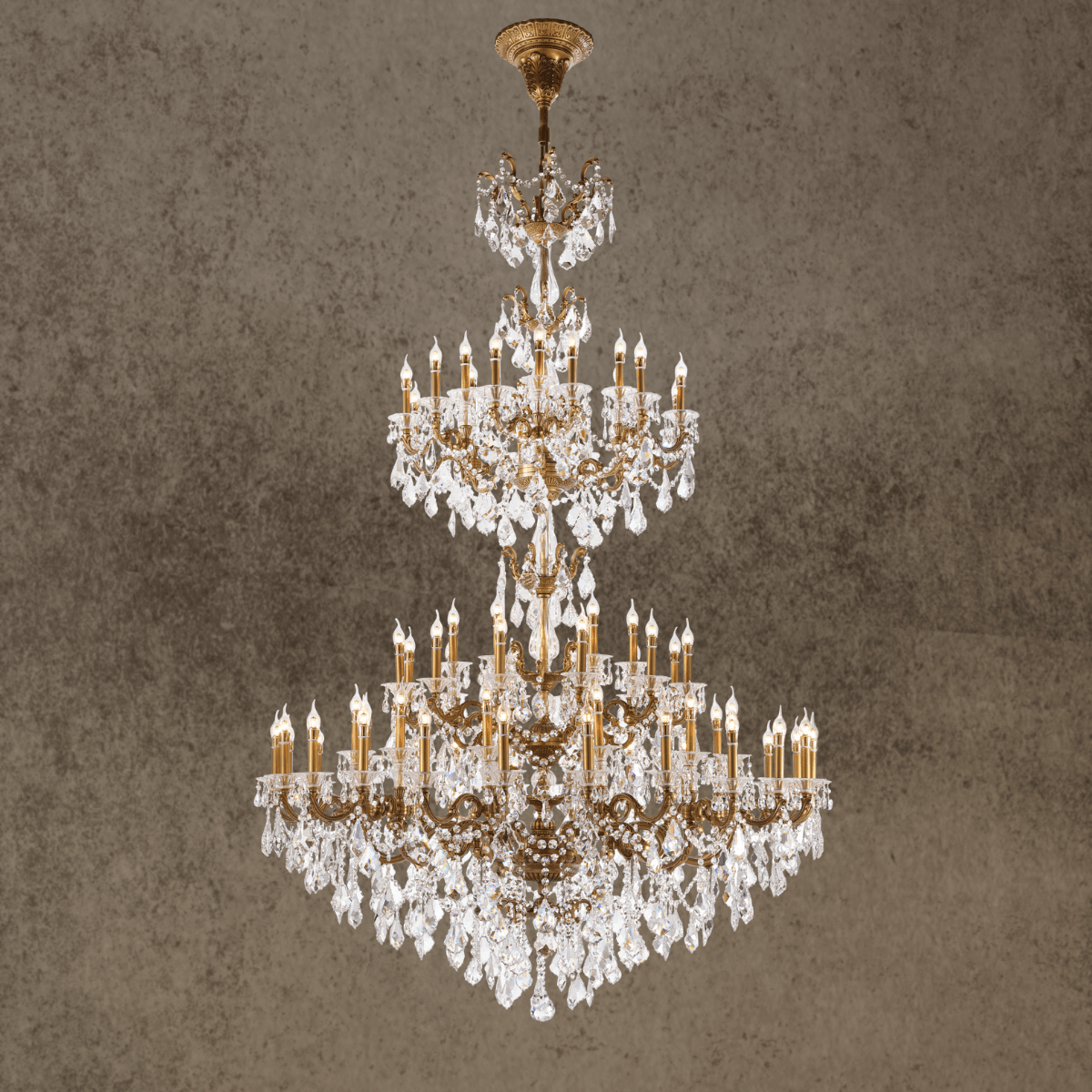
Ø 160 cm (63") × H 250 cm (98")
Bronze plated copper & Asfour Egyptian crystal
View Details
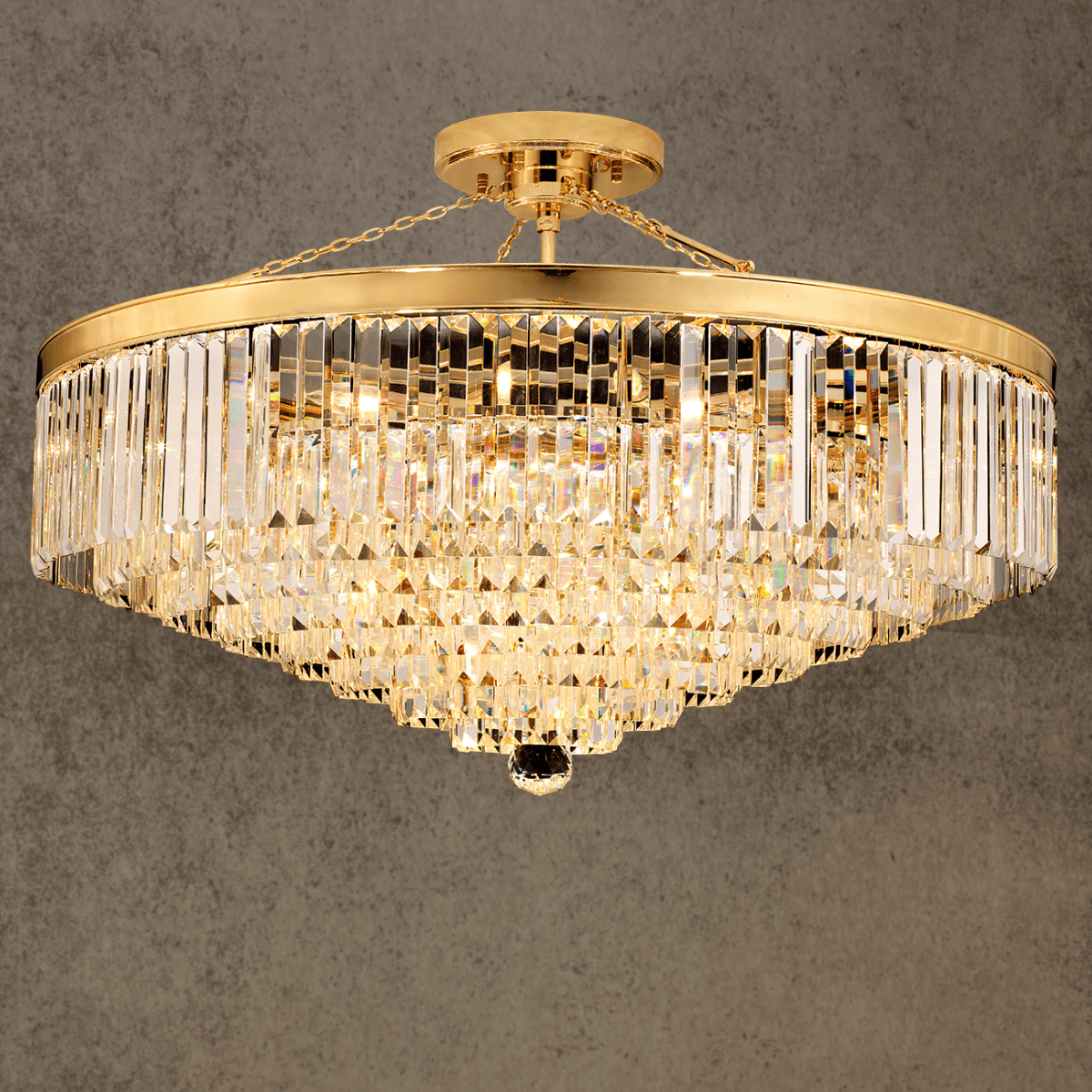
Ø 107 cm (42") × H 45 cm (17.7")
18K gold plated copper & A+ grade lead-free crystal
View Details

Ø 115 cm (45") × H 73 cm (29")
Asfour crystal & 18K gold plated copper
View Details
 Imperial Grace Regina — a Versailles-inspired French Empire chandelier featuring antique bronze finishes, sculptural arms, and cascading Egyptian Asfour crystals.
Detail from the Imperial Grace Collection illustrating classical French metalwork and precision-cut Egyptian crystal craftsmanship.
How French Chandeliers Enhance Architectural Value and Property Appeal
In high-end residential interiors, chandeliers are often the defining architectural feature of a space. A well-proportioned French Empire chandelier installed in a grand foyer or entrance hall establishes hierarchy and scale immediately upon entry. In formal dining rooms, crystal chandeliers anchor the table, define spatial focus, and shape the overall atmosphere.
Beyond aesthetics, such fixtures contribute to perceived property value and long-term design credibility. Exceptional craftsmanship, noble materials, and recognised French heritage styling communicate permanence — qualities highly valued in luxury homes, estate properties, and premium real estate developments worldwide.
 Imperial Grace Éclat — a grand multi-tier French Empire crystal chandelier featuring antique bronze structure and cascading Egyptian Asfour crystals, designed for double-height foyers and architectural staircases.
French Chandeliers in Global Luxury Homes and Hospitality Projects
The influence of French chandelier design extends across international luxury architecture. From historic European hotels and palace-style interiors to contemporary residences in London, Dubai, Beverly Hills, and Monte Carlo, classical crystal chandeliers remain integral to defining space, atmosphere, and architectural identity.
Their continued presence in luxury hospitality venues, private estates, penthouses, and high-end residential developments underscores their adaptability across cultures and architectural styles. In both traditional and modern environments, French chandeliers function as decorative centrepieces and structured lighting elements — bridging heritage craftsmanship with contemporary global design.
For projects across Paris, Monaco, and the Côte d’Azur, explore our dedicated guide to luxury chandelier installations in France and Monaco.
These refined crystal chandeliers demonstrate how French design traditions translate seamlessly into luxury homes, private estates, boutique hospitality venues, and contemporary international interiors.

18K Gold-Plated Copper & A+ Grade Lead-Free Crystal
View Details

Ø 79 cm (32") × H 60 cm (23.6")
18K Gold-Plated Copper / Asfour Crystal
View Details
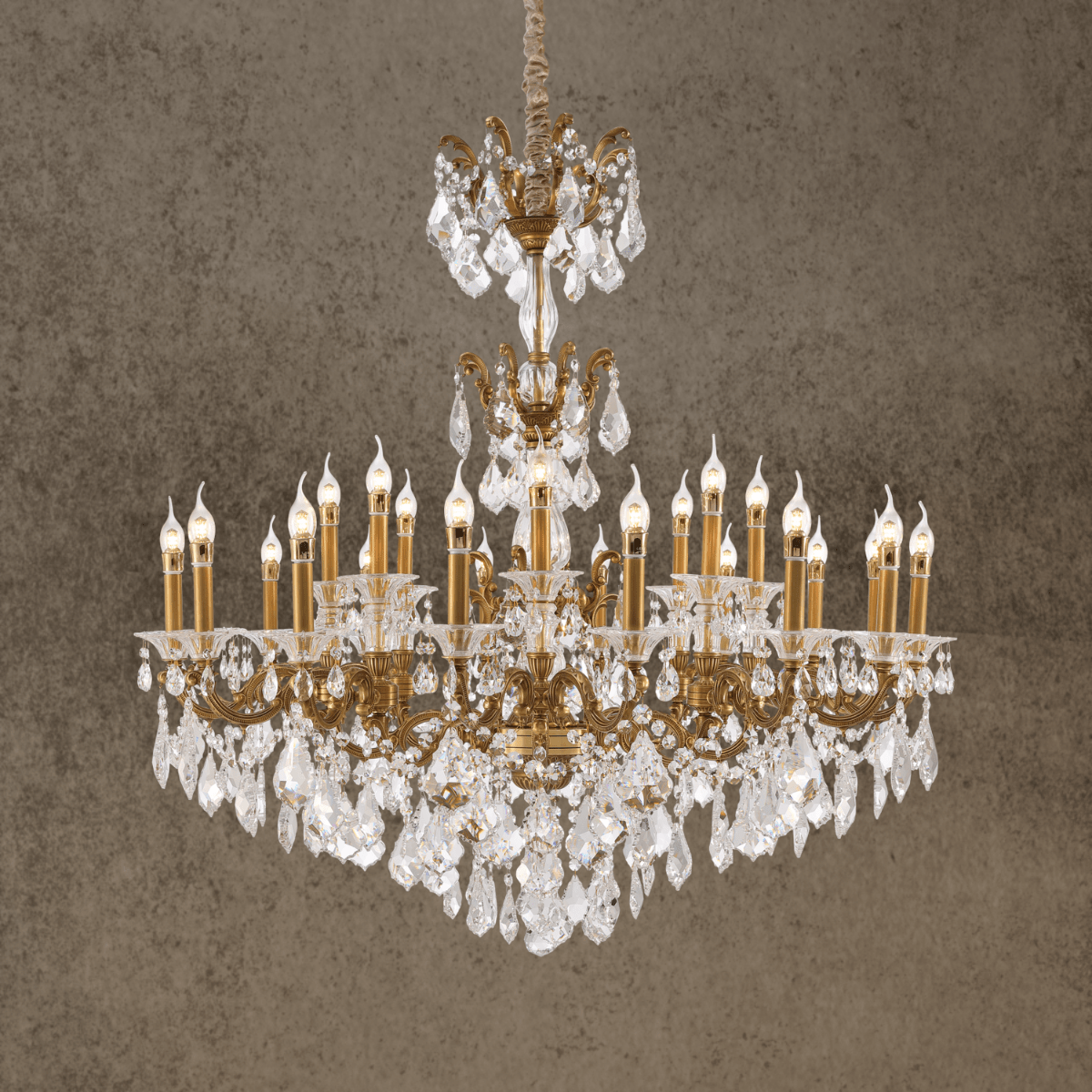
Ø 117 cm (46") × H 118 cm (46")
Asfour Crystal & Bronze-Plated Copper
View Details

Maria Petite Éclat Chandelier within a private estate setting — a French-inspired design crafted for refined bedrooms, salons, and intimate luxury interiors where elegance is expressed through proportion and detail.
Maria Petite Éclat Chandelier — Close-Up Craftsmanship Detail. Precision-set crystal strands and finely finished metalwork demonstrate the level of artisan detailing required for refined private estate interiors, where proportion, material clarity, and craftsmanship define lasting architectural value.
How to Choose the Right French-Style Chandelier Size, Material, and Placement
Selecting a French-style chandelier requires attention to proportion, material, and placement. Correct sizing and positioning ensure the fixture enhances architectural balance rather than overwhelming the space.
For detailed formulas and ceiling recommendations, refer to our Luxury Chandelier Size Guide, which provides sizing methods commonly used in luxury residential and hospitality interiors.
1. Choosing the Correct Chandelier Size and Scale
Scale determines how well a chandelier integrates within a room.
- Ceilings above 3 metres (10 ft): Multi-tier French Empire chandeliers add vertical presence and balance large spaces.
- Standard ceiling heights: Medium-scale chandeliers maintain proportion without crowding the room.
- Bedrooms and smaller spaces: Compact French-style chandeliers create refinement without visual overload.
- Double-height foyers: Large multi-tier designs help fill vertical volume and anchor architectural space.
2. Selecting Materials and Finishes
Materials influence both light quality and interior mood.
- Gold or antique bronze finishes: Ideal for classical and French Empire interiors.
- Refined metal tones: Suitable for transitional or contemporary luxury spaces.
- Crystal: Maximises brilliance and light refraction.
- Murano-style glass: Produces softer, artisanal illumination.
- Fabric shades: Add warmth and controlled light diffusion.
Material selection directly affects atmosphere and visual clarity.
3. Placement and Hanging Height Guidelines
Correct positioning ensures visual harmony.
- Dining tables: Hang chandeliers 70–80 cm (27–31 inches) above the table surface.
- Foyers: Align fixtures with staircases, ceiling medallions, or architectural features.
- Living spaces: Combine chandeliers with sconces or lamps to create layered lighting.
Balanced placement improves both usability and visual structure.
4. Technical and Installation Considerations
Proper planning ensures safety and long-term performance.
- Confirm compatibility with E14 or E27 LED bulbs and dimming systems.
- Ensure certification standards such as CE, UKCA, or UL where required.
- Larger French-style chandeliers require reinforced ceiling support.
Professional installation is recommended for complex or large-scale lighting. Ensure certification standards such as CE, UKCA, or UL where required — particularly for U.S. installations, where compliance plays a critical role in safety, insurance approval, and project acceptance.
Learn more about U.S. compliance and selecting chandeliers for American luxury homes in our Luxury Chandeliers for U.S. Homes Guide.
Why French-Style Chandeliers Are Considered an Architectural Lighting Investment
A French-style chandelier does more than provide illumination — it establishes architectural presence, defines atmosphere, and introduces visual hierarchy within a space. In luxury homes, private estates, and boutique hospitality interiors, chandeliers are often specified not as decorative accessories, but as architectural lighting features that anchor the room.
For interior designers and architects, the chandelier frequently becomes the visual signature of a project — the element that defines first impressions and reinforces design identity. For homeowners, selecting a luxury chandelier represents a long-term investment in craftsmanship, material integrity, and enduring design relevance.
Choosing a French-style chandelier is therefore not solely a decorative decision — it is an architectural investment that contributes to property value, spatial character, and lasting visual impact. For a deeper understanding of long-term value and performance considerations, explore our Luxury Chandelier Investment Guide, which explains why premium chandeliers are often viewed as investment-grade lighting features rather than short-term décor.
 Vendôme Grandeur — a gold-framed French-style crystal chandelier with cascading layered crystal prisms, bringing structured elegance to refined architectural spaces.
The HDLS Design Philosophy: Architectural French-Style Chandeliers Crafted for Timeless Interiors
HDLS Lighting operates as a design-led luxury lighting house, guided by a single principle:
“Handcrafted lighting inspired by heritage and refined through innovation — forged in premium materials for timeless exclusivity.”
Each chandelier begins with the study of proportion, material performance, and architectural precedent. Whether referencing French Empire symmetry, classical ornamentation, or contemporary restraint, HDLS chandelier designs are created to integrate with architecture and endure across generations.
Why French-Style Chandeliers Continue to Define Luxury Architectural Interiors
To select a French-style chandelier is to engage with centuries of design evolution — from Baroque ornamentation to Empire symmetry and modern refinement. These fixtures endure because they unite craftsmanship, scale, and luminous depth within architectural space.
Whether specifying Empire crystal chandeliers, small French-style chandeliers for bedrooms, or grand Versailles-inspired designs for double-height interiors, the essential principles remain constant: noble materials, structural balance, and considered proportion.
French-style chandelier design endures because it is rooted in architecture — and architecture, when thoughtfully interpreted, never goes out of style.


